
Why Freight Centralization Has Become a Competitive Advantage
Managing freight across multiple systems, carriers, and communication channels can quickly become overwhelming. As businesses grow, logistics operations naturally become more complex. More shipments, more customers, more carrier relationships, and more internal stakeholders all create additional layers of coordination that must be managed effectively.
What may begin as a relatively straightforward transportation process can eventually evolve into a fragmented operation where information is spread across spreadsheets, email threads, carrier portals, accounting systems, and various internal communication channels.
When freight operations become disconnected, efficiency often suffers. Teams spend more time searching for information, reconciling data, requesting updates, and managing administrative tasks than they do improving logistics performance. Shipment visibility becomes limited, communication becomes more difficult, and opportunities for cost savings can easily be missed.
Centralizing freight operations helps solve these challenges by bringing transportation management into a single, coordinated framework. Rather than managing freight through multiple disconnected systems, businesses gain access to a streamlined process that improves visibility, simplifies communication, and supports better decision-making.
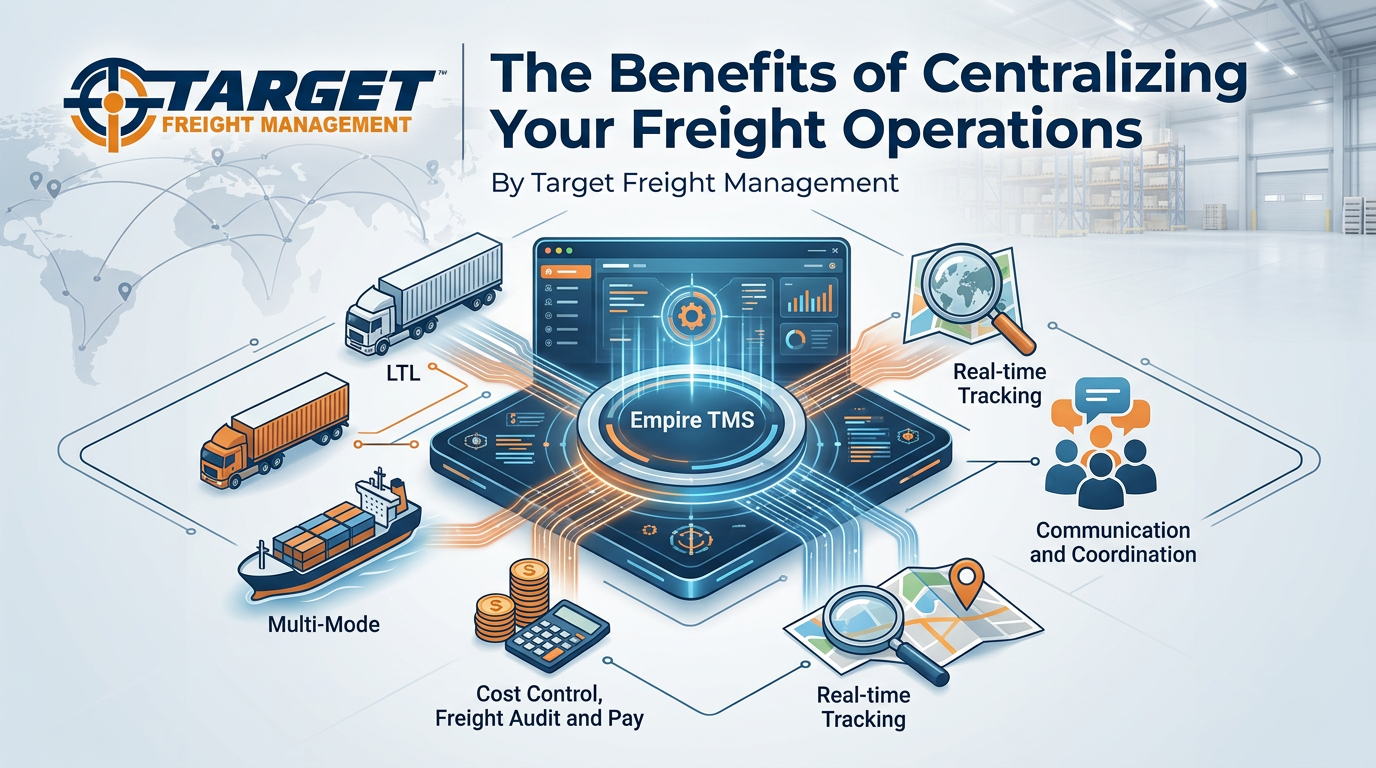
At Target Freight Management, we help businesses centralize their logistics through Empire TMS, combined with services such as LTL management, Freight Audit and Pay, real-time shipment visibility, and operational support. By bringing these functions together, businesses can create a more efficient transportation operation that is easier to manage and easier to scale.
The benefits extend far beyond convenience. Centralization helps improve operational control, strengthen financial oversight, reduce administrative workload, and create a more consistent shipping experience for both internal teams and customers.
In today’s transportation environment, supply chains move faster than ever. Customers expect accurate updates, reliable delivery timelines, and immediate access to shipment information. Internal teams need visibility into transportation costs, carrier performance, and freight activity to make informed decisions. Meeting these expectations becomes increasingly difficult when logistics operations are spread across disconnected systems.
Businesses that centralize freight operations often discover that they can respond faster to challenges, improve service consistency, and identify opportunities for optimization more effectively. Instead of spending valuable time gathering information from multiple sources, teams can focus on improving transportation performance and supporting broader business objectives.
The Challenges of Managing Freight Across Multiple Systems
Many businesses do not intentionally create fragmented logistics operations. Disconnected freight management often develops gradually over time as organizations grow and transportation requirements become more complex.
A company may start with a simple process involving a few carriers and a limited number of shipments each week. As shipping volume increases, additional carriers are added, new locations begin shipping freight, and different departments become involved in transportation decisions.
Over time, information becomes scattered.
Shipment tracking may be handled through carrier websites. Cost reporting may exist in spreadsheets. Documentation may be stored in email folders. Accounting teams may use separate systems for invoice processing. Customer service representatives may rely on entirely different records to answer shipment questions.
Each individual process may function adequately on its own, but collectively these disconnected systems create inefficiencies that become more difficult to manage as shipment volume grows.
Information Becomes Harder to Access
One of the first challenges businesses encounter is the difficulty of locating information quickly.
When shipment details are spread across multiple systems, employees often spend valuable time searching for documentation, verifying shipment status, confirming delivery information, or reviewing transportation costs.
A simple customer inquiry may require checking several different platforms before an accurate answer can be provided.
This slows response times and creates unnecessary administrative work that affects productivity throughout the organization.
The problem becomes even more significant when multiple people need access to the same information. Operations teams, customer service representatives, warehouse personnel, and accounting departments may all need shipment data for different purposes. Without a centralized system, obtaining that information often requires additional emails, phone calls, or manual reporting.
Communication Gaps Become More Common
Fragmented freight operations also increase the likelihood of communication breakdowns.
When different departments are working from different information sources, misunderstandings become more common. Shipment updates may not reach the appropriate teams, delivery expectations may become unclear, and transportation decisions may be made using outdated information.
These communication gaps often lead to avoidable delays, customer frustration, and operational inefficiencies that affect overall supply chain performance.
For example, a shipment delay may be visible to one team but not communicated to another. Customer-facing employees may provide outdated delivery expectations simply because they do not have access to the most current information. Small communication issues like these can quickly affect customer satisfaction and internal productivity.
Centralization addresses these challenges by creating a single source of information that supports stronger coordination and better visibility across the organization.
One System, Complete Visibility
One of the most significant benefits of centralizing freight operations is improved visibility. When transportation information is consolidated into a single platform, businesses gain a clearer view of shipment activity across their entire network.
Instead of switching between multiple systems to gather information, users can access shipment details, transportation costs, tracking updates, carrier information, and supporting documents from one location.
This creates a more efficient workflow while reducing the time required to manage transportation operations.
Improving Day-to-Day Freight Management
Visibility plays an important role in daily logistics execution. When shipment information is easily accessible, teams can respond more quickly to customer inquiries, delivery updates, and operational issues.
For example, if a shipment experiences a delay, centralized visibility allows teams to identify the issue faster and communicate updates more effectively. If proof of delivery documentation is needed, it can be accessed without searching through multiple systems or contacting several different parties.
This level of accessibility improves responsiveness while reducing the administrative burden associated with managing transportation activity.
Centralized visibility also helps reduce uncertainty throughout the shipping process. Rather than waiting for updates from multiple carriers or manually gathering information from different sources, businesses can monitor freight activity through a single interface that provides a more complete operational picture.
Creating Better Operational Awareness
Visibility is not limited to individual shipments. Centralization also helps businesses better understand how their overall freight operation is performing.
With transportation data consolidated into a single system, it becomes easier to identify patterns, evaluate trends, and monitor key performance indicators.
Businesses gain greater insight into carrier performance, shipping costs, transit consistency, and operational efficiency. This information supports more informed decision-making and creates opportunities for continuous improvement.
Rather than making decisions based on assumptions, logistics teams can rely on data that reflects actual transportation performance. This allows businesses to identify recurring issues, monitor service levels, and adjust transportation strategies when needed.
At Target Freight Management, Empire TMS helps provide customers with this centralized visibility so they can manage transportation activity more effectively while maintaining stronger control over their supply chain.
Simplifying LTL and Multi-Mode Shipping
LTL shipping is often one of the most complex areas of freight management. Unlike dedicated truckload transportation, LTL shipments involve varying transit schedules, different carrier networks, multiple service options, and pricing structures that can change significantly from shipment to shipment.
Managing these variables manually can create unnecessary complexity and increase the likelihood of operational errors.
As businesses expand and begin utilizing multiple transportation modes, the challenge becomes even greater.
Different carriers may require different documentation. Service levels may vary across shipment types. Tracking information may be available through separate systems. Managing these processes independently can consume significant time and resources.
Creating Consistency Across Transportation Modes
Centralized freight operations simplify transportation management by creating a consistent process across multiple shipment types and carrier relationships.
Rather than maintaining separate workflows for different modes, businesses can manage transportation activity through one coordinated framework.
This consistency improves operational efficiency while reducing the likelihood of communication errors or process breakdowns.
It also helps logistics teams spend less time navigating administrative complexity and more time focusing on service performance and strategic planning.
As transportation networks become larger, consistency becomes increasingly important. Standardized processes help ensure that shipments are managed according to the same expectations regardless of carrier, service level, or transportation mode.
Improving Carrier Coordination
Carrier management becomes easier when freight operations are centralized.
Instead of managing relationships through multiple portals and communication channels, businesses can coordinate carrier activity through a single platform that provides access to shipment information, rate comparisons, and tracking updates.
Through Empire TMS, customers can compare LTL rates, book shipments, and monitor transportation activity through one interface.
This simplifies the shipping process while helping ensure consistency across every shipment.
Carrier selection also becomes more strategic. Businesses can evaluate carriers based on service performance, transit consistency, and pricing information available within the same system. This supports stronger transportation decisions while reducing the administrative effort required to compare options manually.
Improved Cost Control Through Centralized Data
Cost control is another major advantage of centralizing freight operations. When transportation data is fragmented across multiple systems, gaining a complete understanding of freight spend becomes difficult.
Businesses may be able to see individual shipment costs, but identifying larger spending patterns or operational inefficiencies often requires significant manual effort.
Centralization creates a more complete view of transportation expenses by bringing shipment and financial data together in one place.
Understanding the Full Cost of Transportation
Freight costs involve more than transportation rates alone. Fuel surcharges, accessorial charges, detention fees, reclassification costs, and other expenses can all influence total shipping spend.
Without centralized reporting, these costs may be difficult to analyze consistently.
Businesses often know that freight expenses are increasing but lack the visibility needed to identify exactly why those increases are occurring.
When transportation data is centralized, it becomes easier to evaluate spending patterns and identify areas where improvements can be made.
Finding Opportunities for Savings
A centralized system allows businesses to review costs across carriers, shipping lanes, service types, and geographic regions.
This visibility helps uncover opportunities to reduce inefficiencies and improve transportation strategy.
For example, businesses may identify recurring accessorial charges tied to specific locations, carriers that consistently generate higher costs, or shipment patterns that suggest consolidation opportunities.
Rather than making decisions based on assumptions, businesses can use centralized data to support more informed cost-control initiatives.
At Target Freight Management, centralized reporting helps customers gain greater insight into transportation spend while supporting more strategic logistics planning.
Streamlined Freight Audit and Pay
Another major benefit of centralizing freight operations is improving how transportation invoices are managed. As shipment volume increases, invoice processing becomes more complex. Reviewing invoices across multiple systems, carriers, and communication channels can consume significant time while increasing the likelihood of errors.
Centralization helps simplify this process by bringing shipment records, carrier invoices, supporting documentation, and financial reporting together into one coordinated workflow.
Instead of manually comparing invoices against shipment information stored in multiple locations, businesses can review freight expenses through a more organized and transparent process.
Target Freight Management’s Freight Audit and Pay service supports this effort by verifying invoices against shipment data before payment is approved. This helps reduce discrepancies, minimize overpayments, and improve overall financial control.
By centralizing both operational and financial freight data, businesses gain a stronger understanding of transportation spending while reducing the administrative burden associated with invoice management.
Enhanced Communication and Coordination
Communication is one of the most important factors influencing logistics performance. Even when shipments are planned properly and carriers are selected carefully, communication breakdowns can create delays, confusion, and unnecessary operational challenges.
When freight operations are managed across multiple systems, communication often becomes fragmented. Different teams may be working from different information sources, making it difficult to ensure that everyone has access to the same shipment updates, delivery schedules, and transportation records.
Centralization helps eliminate these challenges by creating a shared operational environment where all stakeholders can access consistent and accurate information.
Instead of relying on scattered email threads, spreadsheets, or separate carrier portals, teams can work from a centralized platform that provides a single source of truth for transportation activity.
Reducing Internal Miscommunication
Internal coordination becomes significantly easier when freight information is centralized.
Operations teams, warehouse personnel, customer service representatives, and accounting departments often need access to the same shipment information for different reasons. When that information is housed within multiple systems, communication gaps become more likely.
For example, customer service teams may provide outdated delivery information if they do not have access to current shipment updates. Warehouse teams may prepare for deliveries based on inaccurate schedules. Accounting departments may spend additional time verifying invoices because shipment records are difficult to locate.
Centralization helps reduce these inefficiencies by ensuring that all departments are working from the same information.
This improves alignment throughout the organization and allows teams to respond more quickly when operational issues arise.
Strengthening Communication With Customers and Carriers
Centralized freight operations also improve external communication.
Customers increasingly expect timely updates regarding shipment status, delivery timelines, and transportation performance. Carriers require accurate instructions and efficient communication to maintain service consistency.
When shipment information is centralized, businesses can provide more accurate updates while reducing the effort required to gather information from multiple sources.
This creates a better experience for customers while helping strengthen relationships with carrier partners.
Clear communication supports stronger logistics performance, and centralization provides the visibility needed to make that communication more effective.
Scalability for Growing Businesses
As businesses grow, logistics operations naturally become more complex. More customers, additional shipping locations, expanded product lines, and increased shipment volume all place greater demands on transportation management processes.
Without the right infrastructure, growth can create operational strain. Teams may find themselves spending more time managing administrative tasks, coordinating carriers, and tracking shipments simply because existing processes are no longer sufficient for the increased workload.
Centralization provides a scalable foundation that allows transportation operations to grow without introducing unnecessary complexity.
Managing Higher Shipment Volumes More Efficiently
One of the primary benefits of centralized freight operations is the ability to manage larger shipment volumes without proportionally increasing administrative effort.
When transportation processes are standardized and information is consolidated, businesses can handle additional freight activity more efficiently.
Instead of creating new workflows for every carrier, shipment type, or customer requirement, organizations can rely on a consistent framework that supports growth while maintaining operational control.
This consistency helps prevent the process breakdowns that often occur when logistics operations expand rapidly.
Supporting Long-Term Business Expansion
Growth often involves entering new markets, serving new customer segments, and expanding transportation networks.
These changes introduce new challenges related to carrier management, shipment visibility, cost control, and service consistency.
Centralized freight operations help businesses adapt more effectively by creating a transportation infrastructure that can support evolving requirements.
Rather than rebuilding logistics processes each time the business grows, organizations can expand within an existing framework that is already designed to support increased activity.
This flexibility helps businesses maintain operational efficiency while pursuing long-term growth opportunities.
How Centralization Supports Better Decision-Making
One of the most valuable outcomes of centralizing freight operations is the ability to make more informed transportation decisions.
When information is fragmented, decision-making often relies on assumptions or incomplete data. Businesses may know that transportation costs are increasing or that service performance is inconsistent, but identifying the root cause can be difficult when information is spread across multiple systems.
Centralization creates a more complete operational picture by bringing transportation data together into one environment.
This allows businesses to evaluate performance more effectively and identify opportunities for improvement.
Using Data to Improve Logistics Strategy
Centralized data makes it easier to analyze trends and evaluate transportation performance over time.
Businesses can review carrier performance, shipping costs, lane efficiency, transit consistency, and operational metrics using information that is accessible and organized.
These insights support stronger decision-making because logistics teams can evaluate actual performance rather than relying on assumptions.
For example, centralized reporting may reveal opportunities to consolidate shipments, adjust carrier allocation, reduce recurring accessorial charges, or improve routing strategies.
Without centralized visibility, these opportunities may be difficult to identify consistently.
Moving From Reactive Management to Proactive Planning
Many transportation operations spend significant time reacting to issues after they occur. Delays, invoice discrepancies, communication challenges, and service disruptions often require immediate attention.
While responding to these issues is necessary, it can prevent teams from focusing on long-term improvement.
Centralization supports a more proactive approach by providing visibility into trends and operational patterns before they become larger problems.
This allows businesses to address inefficiencies earlier and make adjustments that improve transportation performance over time.
The result is a logistics operation that is more strategic, more predictable, and better positioned to support business objectives.
The TFM Approach
At Target Freight Management, we believe that centralization is one of the most effective ways to improve logistics performance. Transportation operations become easier to manage when information, processes, and communication are aligned within a single framework.
Our approach combines technology, carrier relationships, and operational expertise to help customers create a more streamlined freight management experience.
Empire TMS serves as the foundation of this centralized approach by providing shipment visibility, carrier access, reporting capabilities, and transportation management tools within one platform.
Customers gain the ability to manage freight activity more efficiently while maintaining greater visibility into transportation performance.
Combining Technology With Operational Support
Technology is an important component of freight centralization, but technology alone is not enough.
Successful logistics operations also require strong carrier relationships, proactive communication, and operational expertise.
At Target Freight Management, we combine these elements to create a logistics solution that goes beyond software.
Our team works closely with customers to help optimize transportation processes, improve visibility, and identify opportunities for greater efficiency.
This combination of technology and support allows businesses to simplify freight management while maintaining the flexibility needed to respond to changing transportation requirements.
Creating a More Connected Logistics Experience
When transportation information, carrier management, reporting, and financial oversight are connected within a centralized framework, businesses gain greater control over their supply chain.
Instead of managing freight through disconnected systems, customers can operate from a unified environment that supports visibility, coordination, and performance improvement.
This connected approach helps reduce administrative burden while creating a stronger foundation for long-term logistics success.
Turning Complex Logistics Into a More Efficient Operation
Centralizing freight operations is one of the most effective ways to improve efficiency, strengthen visibility, and gain greater control over transportation activity.
By bringing shipment management, carrier coordination, reporting, financial oversight, and communication together into a single framework, businesses can reduce complexity while improving operational performance.
The benefits extend across every stage of the transportation process. Teams gain faster access to information, stronger cost visibility, better communication, improved scalability, and more informed decision-making.
As supply chains continue to evolve, businesses that centralize freight operations will be better positioned to adapt, grow, and maintain consistent service performance.
At Target Freight Management, we help customers simplify logistics through centralized technology, transportation expertise, and operational support designed to improve efficiency across every shipment.