
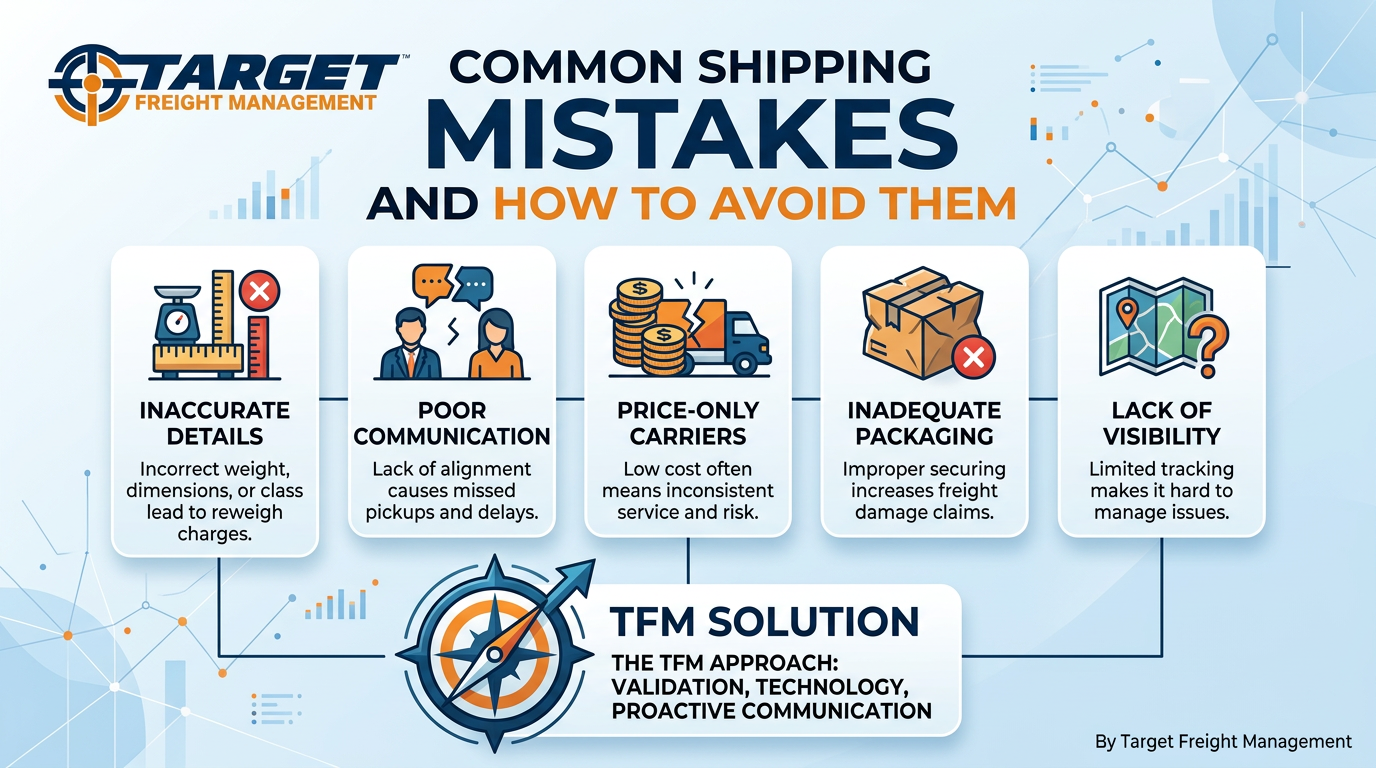
Why Small Shipping Mistakes Create Bigger Operational Problems
Shipping freight may seem straightforward, but even small mistakes can lead to significant delays, added costs, and operational disruptions. Many shipping issues are preventable, yet businesses often underestimate how quickly minor errors can affect the larger supply chain.
A shipment with incorrect dimensions, incomplete documentation, unclear delivery instructions, or poor packaging may only appear to be a small oversight at first. However, once freight enters transit, those mistakes can create a chain reaction that affects carrier scheduling, customer expectations, billing accuracy, and operational efficiency.
As supply chains become more complex and customer expectations continue to rise, avoiding preventable shipping mistakes becomes increasingly important. Delays that once may have been considered manageable now have a greater impact on production schedules, inventory planning, and customer relationships.
At Target Freight Management, we help customers identify common freight shipping mistakes and implement processes that reduce risk, improve consistency, and create more efficient transportation operations.
Avoiding shipping issues is not just about solving problems after they occur. It requires a more proactive approach focused on accuracy, communication, visibility, and operational planning from the beginning of the shipment process.
Inaccurate Shipment Details
One of the most common issues in freight shipping is inaccurate shipment information. Errors involving shipment weight, dimensions, freight classification, addresses, or commodity descriptions can create significant operational and financial problems once freight is in transit.
Carriers rely on shipment information to plan trailer space, determine pricing, allocate equipment, and schedule delivery timelines. When shipment details are incorrect, those processes become disrupted.
For example, inaccurate dimensions or freight classifications often result in reweigh charges or reclassification fees. These additional costs can increase freight spend unexpectedly while also creating billing disputes that require time and administrative effort to resolve.
Incorrect addresses or incomplete delivery information can create missed appointments, delayed deliveries, or failed pickup attempts that affect service consistency and customer satisfaction.
How Small Errors Create Larger Delays
Many shipment inaccuracies seem minor during the booking process but create larger disruptions later in transit.
For example, if a shipment is entered with dimensions that underestimate the actual freight size, the carrier may discover the discrepancy after pickup. At that point, the shipment may need to be reclassified or adjusted operationally, which can delay movement and affect trailer planning.
Similarly, if delivery requirements such as liftgate service, appointment scheduling, or limited-access information are not communicated upfront, carriers may be unable to complete delivery as originally planned.
These issues not only create additional charges but also reduce shipment consistency and increase the likelihood of service disruptions.
Improving Shipment Accuracy
Preventing these issues starts with stronger validation processes before freight is booked.
Businesses should verify:
- Shipment weight and dimensions
- Freight classification
- Pickup and delivery addresses
- Commodity descriptions
- Special handling requirements
- Appointment instructions
- Packaging specifications
Accurate shipment information improves carrier planning, reduces billing discrepancies, and supports smoother transportation execution from pickup through final delivery.
At Target Freight Management, shipment validation is an important part of reducing operational risk and helping customers maintain stronger shipping consistency.
Poor Communication Between Parties
Lack of communication is another major source of freight shipping problems. Even well-planned shipments can experience delays and confusion when communication breaks down between shippers, carriers, warehouses, drivers, and receivers.
Freight transportation involves multiple parties coordinating around timelines, appointments, documentation, and shipment requirements. When communication is incomplete or inconsistent, operational gaps begin to appear.
Missed pickups, delayed deliveries, appointment conflicts, and shipment confusion are often tied directly to communication failures rather than transportation limitations alone.
Where Communication Breakdowns Commonly Occur
One of the most common issues occurs when shipment expectations are not clearly communicated upfront.
For example, if a carrier is not informed about delivery appointment requirements before pickup, the shipment may arrive at the destination without a scheduled receiving window. This can lead to detention time, delivery rescheduling, or refused freight.
Likewise, if warehouse teams are unaware of pickup timing changes, freight may not be prepared when the carrier arrives, disrupting both the shipment schedule and the carrier’s route planning for the remainder of the day.
Even small communication gaps can create delays that affect multiple parts of the supply chain.
Why Proactive Communication Matters
Strong communication helps prevent confusion before issues escalate into operational disruptions.
Providing clear instructions, confirming appointments, sharing updates proactively, and maintaining visibility throughout transit all contribute to more reliable shipment execution.
This includes:
- Confirming pickup and delivery appointments
- Providing accurate contact information
- Communicating shipment delays early
- Sharing documentation promptly
- Updating customers when transit conditions change
At Target Freight Management, proactive communication is a core part of our shipping process. We work closely with carriers, customers, and receiving facilities to help ensure that shipment expectations remain aligned throughout transit.
This level of coordination reduces confusion, improves consistency, and helps prevent avoidable service disruptions.
Choosing Carriers Based Solely on Price
Freight rates are important, but choosing carriers based solely on price often creates larger operational problems over time.
Lower-cost carriers may appear attractive upfront, especially when businesses are focused on reducing transportation spend. However, low rates do not always deliver the best long-term value.
Inconsistent service, delayed communication, missed appointments, and increased claims activity can quickly offset any short-term cost savings gained through lower pricing.
When carrier performance is unreliable, the operational impact often extends beyond transportation itself.
Delayed shipments can disrupt production schedules, create customer service issues, increase internal workload, and affect inventory planning across the organization.
The Difference Between Cost and Value
Freight pricing should always be evaluated alongside operational performance.
A carrier with a slightly higher rate may provide:
- Better transit consistency
- Fewer damage claims
- Stronger communication
- More reliable appointment performance
- Lower operational disruption overall
Over time, these advantages often create greater value than simply selecting the lowest transportation rate available.
Businesses that focus only on upfront pricing may unintentionally increase total operational cost through delays, service failures, and administrative inefficiencies.
Using Data to Support Carrier Selection
Carrier performance should be evaluated using measurable operational data rather than assumptions alone.
Metrics such as:
- On-time delivery percentage
- Claims frequency
- Transit consistency
- Communication responsiveness
- Appointment reliability
All provide insight into how carriers perform across real-world shipment activity.
At Target Freight Management, we track carrier performance across multiple operational categories to help customers balance both cost and service quality more effectively.
This balanced approach helps create more reliable transportation operations while reducing long-term freight risk.
Inadequate Packaging and Handling
Improper packaging is one of the most preventable causes of freight damage. When shipments are not packaged correctly, they become more vulnerable to movement, compression, vibration, and handling impacts throughout transit.
Freight moves through multiple environments before final delivery. Shipments may be transferred between terminals, stacked alongside other freight, moved using forklifts, or exposed to changing road conditions during transit.
Without proper packaging and palletization, the risk of damage increases significantly.
Damaged freight creates additional transportation costs, customer dissatisfaction, shipment replacement expenses, and operational delays that affect supply chain performance overall.
Common Packaging Mistakes
Some of the most common packaging issues include:
- Insufficient pallet wrapping
- Unsecured freight movement
- Improper weight distribution
- Weak packaging materials
- Overhanging freight on pallets
- Inadequate protection for fragile items
These issues may seem small during shipment preparation, but they often become significant once freight enters transit and experiences repeated handling.
How Better Packaging Improves Freight Performance
Using appropriate packaging materials and following best practices for palletization helps improve shipment stability and reduce damage risk.
This includes:
- Securing freight tightly to pallets
- Using proper wrapping and strapping methods
- Protecting corners and fragile surfaces
- Distributing weight evenly
- Preventing product overhang
Improved packaging not only reduces claims frequency but also supports smoother handling throughout transit, helping carriers move freight more efficiently and safely.
At Target Freight Management, we work with customers to help identify packaging practices that improve shipment reliability and reduce avoidable transportation risk.
Lack of Visibility and Tracking
Without proper shipment visibility, businesses are often forced to react to problems after they occur instead of proactively managing freight performance throughout transit.
Limited tracking makes it difficult to understand where shipments are located, whether deliveries are staying on schedule, or how operational issues may affect customer expectations.
This lack of visibility creates uncertainty across the supply chain. Customer service teams may struggle to provide updates, warehouse operations may be unable to prepare for delivery timing changes, and logistics teams may lose valuable time trying to gather shipment information manually.
In today’s transportation environment, real-time visibility has become one of the most important tools for maintaining operational control.
Why Reactive Freight Management Creates Problems
When shipment visibility is limited, operational teams often discover problems too late to prevent disruption.
For example, if a shipment is delayed due to weather, traffic congestion, or appointment issues, businesses without tracking visibility may not learn about the delay until after the expected delivery time has passed.
At that point, customer expectations have already been affected, and operational teams are left reacting under pressure instead of managing the issue proactively.
Reactive freight management also increases internal workload. Teams spend more time making check calls, requesting updates, searching for documentation, and responding to avoidable customer concerns.
This creates inefficiencies that extend beyond transportation costs alone.
How Real-Time Visibility Improves Freight Operations
Implementing real-time tracking solutions provides the insight needed to maintain stronger shipment control throughout transit.
Visibility tools allow businesses to:
- Monitor shipment progress in real time
- Identify delays earlier
- Communicate proactively with customers
- Adjust delivery expectations when needed
- Improve coordination across internal teams
- Reduce uncertainty throughout the shipping process
This level of transparency helps businesses respond more effectively when operational disruptions occur while also improving day-to-day shipment management overall.
At Target Freight Management, visibility is a core part of helping customers maintain stronger logistics performance. Through technology-driven tracking and centralized shipment management, customers gain better insight into freight activity from pickup through final delivery.
Failing to Prepare for Exceptions and Delays
Even well-planned shipments can encounter unexpected disruptions. Weather conditions, traffic congestion, equipment failures, staffing shortages, and facility delays all have the potential to affect freight movement.
One of the most common shipping mistakes businesses make is assuming that every shipment will move exactly as planned without building flexibility into the process.
When businesses fail to prepare for exceptions, even minor disruptions can create larger operational problems.
For example, a delivery delay may affect production schedules, labor planning, customer appointments, or downstream shipments connected to the same supply chain timeline.
Without contingency planning, these disruptions become much more difficult to manage effectively.
Why Contingency Planning Matters
Contingency planning does not eliminate disruptions, but it helps reduce the operational impact when issues occur.
Businesses that prepare for delays are often able to respond faster, communicate more effectively, and minimize service interruptions more successfully.
This may include:
- Building realistic delivery windows
- Allowing buffer time for critical shipments
- Maintaining backup carrier options
- Improving customer communication processes
- Monitoring high-risk lanes more closely
Operational flexibility becomes especially important during periods of high freight volume or changing market conditions when delays become more common across the transportation network.
Using Visibility to Respond More Effectively
Real-time shipment visibility also supports stronger exception management.
When logistics teams can identify potential delays earlier, they have more time to communicate updates, adjust delivery plans, and coordinate with customers before disruptions escalate further.
This proactive approach reduces uncertainty and helps maintain stronger service reliability even when challenges arise during transit.
At Target Freight Management, we focus on helping customers prepare for operational variability by improving visibility, strengthening communication, and creating more proactive logistics processes.
Overlooking the Importance of Internal Coordination
Shipping performance is not determined by transportation providers alone. Internal coordination between departments also plays a major role in how efficiently freight moves through the supply chain.
Warehouse operations, customer service teams, purchasing departments, production schedules, and logistics coordinators all influence shipment readiness and transportation performance in different ways.
When these teams operate independently without strong communication or standardized processes, shipping mistakes become more likely.
How Internal Misalignment Affects Freight Operations
For example, if warehouse personnel are unaware of updated pickup schedules, freight may not be prepared when carriers arrive. If customer service teams do not have accurate shipment visibility, they may communicate incorrect delivery expectations to customers.
Likewise, if production schedules change without proper coordination, transportation planning may no longer align with shipment readiness timelines.
These types of operational disconnects create avoidable delays and reduce shipment consistency throughout the logistics process.
Creating Stronger Operational Alignment
Improving coordination starts with creating more consistent communication and visibility across departments.
Businesses can strengthen alignment by:
- Standardizing shipment procedures
- Improving communication between teams
- Centralizing shipment visibility
- Clarifying operational responsibilities
- Establishing stronger scheduling processes
When departments work from the same shipment information and operational expectations, freight execution becomes more consistent and easier to manage.
At Target Freight Management, we help customers strengthen logistics coordination by improving visibility and creating processes that support more reliable shipment execution across the entire supply chain.
The TFM Approach
At Target Freight Management, we help customers avoid common shipping mistakes through a combination of operational oversight, technology-driven visibility, shipment validation, and proactive communication.
Our goal is not simply to move freight from one location to another. We focus on creating a smoother, more reliable transportation process that reduces operational risk and improves long-term shipping consistency.
This starts with stronger shipment accuracy. By validating shipment details early in the process, we help reduce issues related to incorrect dimensions, freight classifications, addresses, and delivery requirements.
We also prioritize communication throughout every stage of shipment execution. Coordinating closely with shippers, carriers, and receivers helps reduce confusion, improve appointment management, and support stronger service reliability.
Freight technology also plays an important role in improving shipment performance.
Through centralized tracking and visibility tools, customers gain better insight into shipment status, operational performance, and transportation activity throughout transit.
This level of visibility supports faster decision-making while helping customers respond more proactively when challenges arise.
At TFM, we believe avoiding shipping mistakes starts with building stronger logistics processes that improve visibility, consistency, and operational coordination across every shipment.
Building a More Reliable Shipping Process
Avoiding common shipping mistakes is one of the most effective ways to improve logistics performance over time.
Many transportation issues are preventable when businesses focus on shipment accuracy, communication, visibility, packaging, carrier performance, and operational planning from the beginning of the process.
Small improvements in these areas often create meaningful long-term benefits, including:
- Reduced transportation costs
- Fewer shipment delays
- Improved customer satisfaction
- Lower claims frequency
- Stronger operational efficiency
- More reliable supply chain performance
As logistics operations become more complex, businesses that prioritize proactive freight management will be better positioned to maintain consistency and reduce avoidable disruptions.
At Target Freight Management, we help customers create more efficient shipping processes through stronger planning, better visibility, and operational support designed to improve long-term transportation performance.