
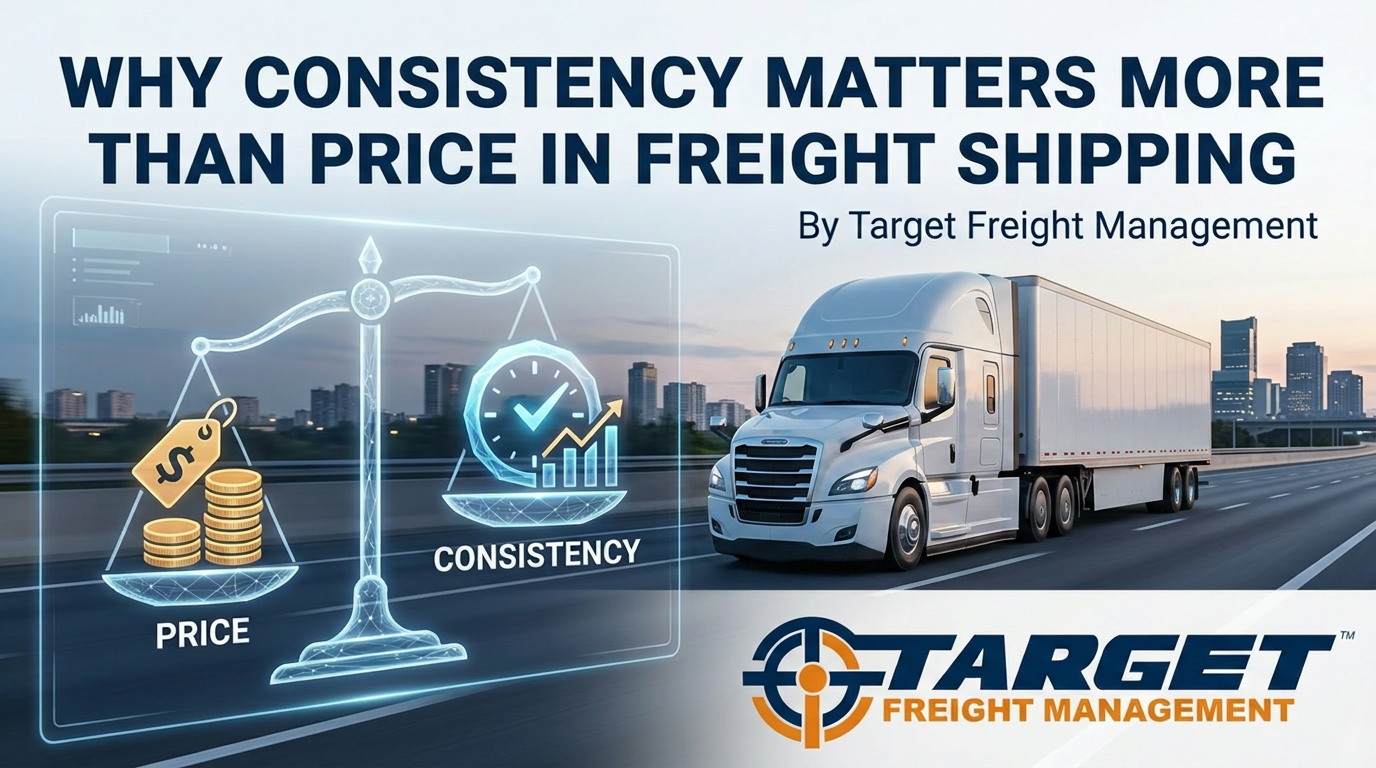
Looking Beyond Price in Freight Decisions
In freight shipping, cost is often the first factor companies consider. It’s easy to understand why. Freight spend is a visible, recurring expense, and reducing that number feels like a direct win for the business. However, focusing only on price can create blind spots that lead to larger operational issues over time.
What many businesses discover as they grow is that the lowest rate does not always translate into the best outcome. Freight shipping is not just a transaction — it is a process that impacts inventory, production timelines, customer satisfaction, and overall business performance.
When companies evaluate logistics partners or carriers based solely on price, they often overlook the factors that actually determine long-term success. Service reliability, communication, consistency, and performance history all play a critical role in how well a shipment moves from origin to destination.
Consistency is what allows logistics operations to function predictably. It creates stability across shipments, reduces uncertainty, and helps businesses maintain control over their supply chain. Without consistency, even low-cost shipping can become expensive due to disruptions, delays, and inefficiencies.
At Target Freight Management, we work with customers to shift their perspective. Instead of focusing only on rate, we help them evaluate freight decisions based on overall performance. This approach leads to stronger operations, better customer experiences, and more sustainable cost control over time.
Understanding the difference between price and value is key. While price reflects the immediate cost of a shipment, value is determined by how that shipment performs within the larger operation.
This distinction becomes increasingly important as businesses scale. The more shipments you move, the more impact consistency has on your ability to maintain efficiency and meet expectations.
The Hidden Cost of Cheap Freight
Choosing the lowest available rate may seem like a smart financial decision at first glance. However, lower-cost options often come with trade-offs that are not immediately visible.
Carriers offering significantly lower rates may be operating with tighter margins, which can affect service quality. This may show up in several ways, including inconsistent pickup times, longer transit windows, or reduced communication during transit.
In some cases, lower-cost carriers may also have higher claims rates. This means a greater likelihood of damaged or lost freight, which introduces additional costs that were not accounted for when the shipment was initially booked.
When these issues occur, the impact extends beyond the individual shipment. A delayed delivery can disrupt production schedules, delay customer orders, or require expedited replacements. Each of these scenarios adds cost back into the operation, often exceeding the savings gained from choosing the lower rate.
There is also a time cost to consider. When shipments do not move as expected, internal teams must spend time tracking down updates, resolving issues, and communicating with customers. This reduces efficiency and shifts focus away from more strategic activities.
Over time, these hidden costs accumulate. What initially appeared to be a cost-saving decision can result in higher overall spend when factoring in disruptions, rework, and lost productivity.
Another important consideration is predictability. Low-cost carriers may perform well occasionally but lack consistency across shipments. This inconsistency makes it difficult to plan operations effectively, as outcomes become less reliable.
In contrast, a slightly higher rate paired with consistent performance often delivers better results. When shipments move as expected, businesses can operate more efficiently, reduce risk, and maintain stronger control over their logistics processes.
Understanding the full cost of freight requires looking beyond the invoice. It requires evaluating how shipments perform and how that performance impacts the broader operation.
Reliability Builds Stronger Operations
Consistency in freight shipping creates a foundation for reliable operations. When shipments move on time and arrive in good condition, businesses can plan with confidence.
Reliable logistics allows companies to maintain production schedules, manage inventory levels more effectively, and meet delivery commitments without constant adjustments. This stability reduces stress across teams and supports smoother day-to-day operations.
When reliability is lacking, even well-planned operations can become unpredictable. Delays in inbound shipments can slow production, while late outbound deliveries can impact customer satisfaction and revenue.
Consistency eliminates much of this uncertainty. By working with carriers that demonstrate dependable performance, businesses can reduce variability and create a more controlled environment for managing freight.
This level of control becomes increasingly important as shipment volume grows. With more shipments in motion, the impact of inconsistencies is amplified. A single delay may be manageable, but repeated issues across multiple shipments can quickly create larger operational challenges.
Reliable logistics partners help mitigate these risks. They provide consistent service, maintain clear communication, and address issues proactively when they arise.
At Target Freight Management, we focus on building reliability into every aspect of the shipping process. This includes selecting carriers based on performance history, monitoring shipments closely, and maintaining communication throughout transit.
The result is a more predictable logistics operation that supports both efficiency and growth.
Customer Expectations Continue to Rise
In today’s market, customer expectations around delivery performance are higher than ever. Businesses are expected to provide accurate delivery timelines, consistent service, and clear communication throughout the shipping process.
When shipments are delayed or inconsistent, customers notice. Late deliveries can disrupt their own operations, delay projects, or impact their ability to serve their customers.
These experiences influence how customers perceive your business. Even if the issue originates within the logistics process, the responsibility ultimately falls on the company delivering the product.
Consistency in freight shipping helps protect against these risks. When deliveries arrive on time and as expected, customers gain confidence in your ability to meet their needs.
This consistency strengthens relationships over time. Customers are more likely to continue working with businesses that provide dependable service, even if pricing is not always the lowest available.
On the other hand, inconsistent performance can erode trust quickly. Repeated delays or communication gaps can lead customers to seek alternative suppliers who offer more reliable service.
Maintaining consistency in logistics is not just about operational efficiency. It is also a key component of customer experience and long-term retention.
By prioritizing reliability, businesses can meet rising expectations and differentiate themselves in a competitive market.
Data-Driven Carrier Selection
Achieving consistency in freight shipping requires more than experience or intuition. While industry knowledge plays an important role, long-term performance is driven by data. Understanding how carriers perform across different lanes, shipment types, and service levels allows businesses to make more informed decisions.
Without data, carrier selection often relies on habit or familiarity. A carrier that has been used in the past may continue to be selected without evaluating whether it is still the best option. Over time, this can lead to missed opportunities for improvement and reduced overall performance.
A data-driven approach changes how decisions are made. Instead of focusing solely on price, businesses can evaluate carriers based on measurable performance indicators. These include on-time delivery rates, claims frequency, transit consistency, and communication responsiveness.
By analyzing these metrics, it becomes easier to identify which carriers consistently meet expectations and which ones introduce risk into the operation. This level of insight allows for more strategic carrier selection, ensuring that each shipment is matched with a provider that aligns with both cost and service requirements.
At Target Freight Management, we track carrier performance across a wide range of data points. This allows us to build a clearer picture of how each carrier performs in real-world conditions, not just in isolated situations.
For example, a carrier may offer competitive pricing but struggle with on-time performance in certain regions. Another carrier may have slightly higher rates but deliver consistently across multiple lanes. Without data, these differences may not be immediately visible.
By leveraging performance data, we help our customers make decisions that prioritize reliability while still maintaining cost control. This balanced approach ensures that shipments move efficiently without sacrificing service quality.
Data-driven carrier selection also supports continuous improvement. As more shipment data is collected, trends become clearer, allowing businesses to refine their strategies and adapt to changing conditions.
This ongoing evaluation process ensures that carrier performance is not just monitored, but actively managed to support long-term consistency.
Long-Term Value Over Short-Term Savings
While lower rates may offer immediate savings, the true value of a logistics strategy is measured over time. Short-term cost reductions can be appealing, but they often come at the expense of consistency, reliability, and overall performance.
When businesses prioritize consistency, they create a more stable and predictable operation. This stability reduces the likelihood of disruptions, minimizes the need for reactive decision-making, and supports better long-term planning.
Over time, consistent performance leads to fewer delays, reduced claims, and improved coordination across the supply chain. Each of these factors contributes to cost savings that extend beyond the initial rate.
For example, fewer delays mean less need for expedited shipments. Reduced claims minimize the costs associated with damaged or lost freight. Improved coordination helps prevent inefficiencies that can add unnecessary expense to the operation.
These benefits may not be immediately reflected in a single shipment cost, but they have a significant impact when viewed across the entire logistics operation.
Consistency also supports stronger relationships with customers and partners. When shipments arrive as expected, businesses build a reputation for reliability. This reputation can lead to increased customer retention and new opportunities for growth.
In contrast, focusing solely on price can create instability. Inconsistent service may lead to disruptions that affect not only logistics operations but also customer satisfaction and overall business performance.
At Target Freight Management, we help our customers evaluate logistics decisions through a long-term lens. Instead of focusing on isolated cost savings, we look at how each decision impacts overall performance and efficiency.
This approach ensures that cost control is achieved without compromising the factors that drive sustainable growth.
The TFM Approach to Consistency
Consistency in freight shipping does not happen by chance. It requires a structured approach that combines the right carriers, the right processes, and the right level of oversight.
At Target Freight Management, we prioritize consistency by building our operations around performance and reliability. This starts with carrier selection. We work with trusted carriers that have demonstrated consistent service across key performance metrics.
However, selecting the right carriers is only part of the process. Maintaining consistency also requires ongoing monitoring and communication. Each shipment is tracked closely to ensure it is moving as expected, and any issues are addressed proactively.
Communication plays a critical role in this process. Clear, timely updates help ensure that all stakeholders are informed and aligned throughout the shipment lifecycle. This reduces uncertainty and allows for faster response when adjustments are needed.
In addition to operational oversight, we leverage technology to support consistency. Tools such as Empire TMS provide real-time visibility into shipment status, allowing both our team and our customers to monitor progress and stay informed.
This combination of technology and hands-on management creates a more controlled logistics environment. Instead of reacting to issues after they occur, we focus on preventing disruptions through proactive planning and monitoring.
Our goal is to deliver predictable results that our customers can rely on. By maintaining a consistent approach across every shipment, we help businesses build a stronger and more efficient supply chain.
Consistency as a Competitive Advantage
In a competitive market, consistency can become a key differentiator. While many businesses focus on pricing as a way to gain an advantage, reliability and performance often have a greater impact on long-term success.
Customers value dependability. They want to know that their shipments will arrive on time, in good condition, and with clear communication along the way. When businesses consistently meet these expectations, they build trust and strengthen relationships.
This trust can lead to increased loyalty, repeat business, and positive referrals. Over time, these factors contribute to growth and stability, creating a competitive advantage that goes beyond pricing.
Consistency also improves internal operations. When logistics processes are predictable, teams can plan more effectively, reduce stress, and focus on strategic initiatives rather than constantly managing disruptions.
This creates a more efficient and productive work environment, supporting overall business performance.
In contrast, inconsistent logistics can create uncertainty and reduce confidence in the supply chain. This can impact decision-making, slow down operations, and limit the ability to scale effectively.
By prioritizing consistency, businesses position themselves for long-term success. They create a logistics strategy that supports both operational efficiency and customer satisfaction.
At Target Freight Management, we view consistency as a core component of competitive advantage. By focusing on reliability and performance, we help our customers build stronger operations and deliver better results.
Building a Stronger Supply Chain Through Reliability
A strong supply chain is built on reliability. Each component, from carrier selection to shipment execution, plays a role in maintaining consistent performance.
When reliability is prioritized, the entire supply chain becomes more resilient. Businesses are better equipped to handle disruptions, adapt to changes, and maintain service levels even in challenging conditions.
Consistency also supports better collaboration between partners. When expectations are clear and performance is predictable, communication improves and coordination becomes more effective.
This collaborative environment allows businesses to work more closely with carriers, suppliers, and customers, creating a more integrated and efficient supply chain.
Over time, these improvements contribute to a stronger overall operation. Costs become more predictable, performance becomes more consistent, and the ability to scale increases.
At Target Freight Management, we focus on building reliability into every aspect of the supply chain. By combining data, technology, and operational expertise, we help our customers create a logistics strategy that supports long-term success.
Why Consistency Should Lead Your Freight Strategy
Price will always be an important factor in freight shipping, but it should not be the only factor. Businesses that prioritize consistency gain a clearer understanding of their logistics performance and create a more stable foundation for growth.
Consistency reduces uncertainty, improves efficiency, and supports better decision-making. It allows businesses to operate with confidence, knowing that their shipments will move as expected.
By focusing on reliability rather than short-term savings, companies can build a logistics strategy that delivers long-term value. This approach helps reduce disruptions, improve customer satisfaction, and create a more efficient operation overall.
At Target Freight Management, we help our customers take a more strategic approach to freight shipping. By prioritizing consistency, we support stronger performance and more predictable outcomes across every shipment.